
Diagnosis
Respond quickly and identify
Managing OHE starts with timely identification
Routinely ask and assess your patients with chronic liver disease (CLD) and cirrhosis for symptoms of OHE
- Take a detailed patient history to assess what is new and/or has changed since their last visit. The following can put patients at risk of developing OHE:
- Recent infections, or procedures requiring hospitalization (eg, banding or TIPS procedures, bariatric surgery)1-3
- Presence of other CLD complications, such as portal hypertension or varices1
- Changes in medications (eg, diuretics, beta blockers, opioids)2,4
- Check for physical and mental signs of OHE2
- Counsel patients and their caregivers on the risk of complications, including signs and symptoms related to OHE2
You can help patients at risk of overt HE recurrence by screening today: Check for physical and mental changes2
As the burden of CLD/cirrhosis increases, so do hospital readmissions. HE is a common driver for such readmissions.5
Routinely assess patients’ mental, behavioral, and physical state by asking them and their caregivers these simple questions:
- Have you experienced or has your caregiver reported episodes of reduced cognitive abilities, such as confusion, disorientation, or sleepiness?
- Have you experienced or has your caregiver reported a change in personality or increase in inappropriate or bizarre behavior?
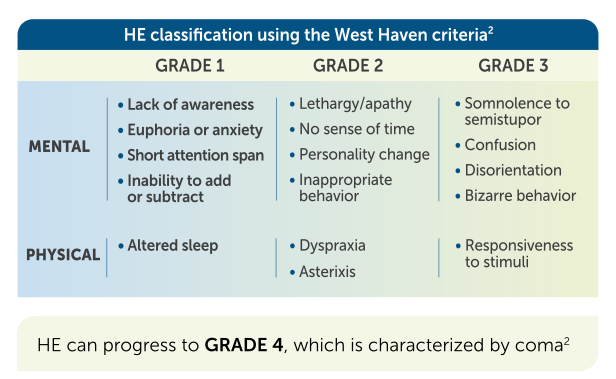
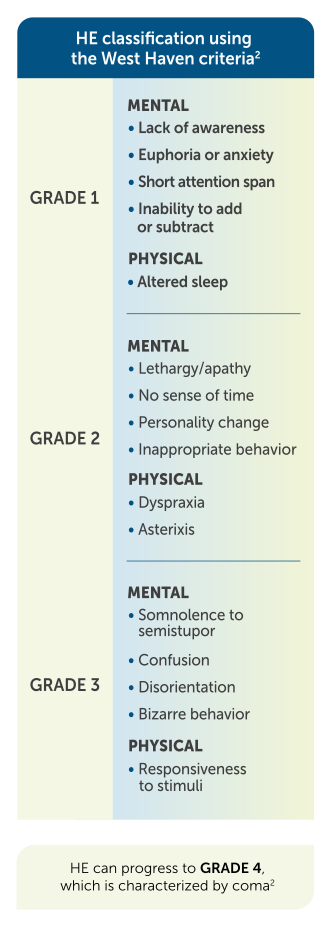
- 30% to 40% of patients with cirrhosis will develop OHE2
Counsel patients on risks2
Upon diagnosis of cirrhosis, counsel your patients and their caregivers on the risk of complications, including the above signs and symptoms of OHE.
Caregivers can play a critical part in the management of patients with HE
Your patients may not exhibit outward signs of HE at the time of their appointments. Therefore, it is important to ask both patients and their caregivers whether they've experienced (or witnessed) any of the symptoms.7
One study found caregivers identified 25% of HE episodes8
Part of a holistic approach to managing HE is considering available guidelines9,10

The ACG recommends XIFAXAN (Strong Recommendation, High Certainty of Evidence).9,* Key clinical concepts in the diagnosis and management of HE9:
- Identify and treat underlying precipitating factors
- Perform specific assessments for alternative diagnoses for cognitive complaints
- Provide educational materials to patients and family caregivers
- Begin first-line treatment with lactulose therapy
*Per the ACG, GRADE methodology was used to assess the quality of evidence and provide the strength of each recommendation. Strong: most patients should receive the recommended course of action; Conditional: a shared decision-making model through discussion regarding the available evidence and alternative options is appropriate. High: very confident in estimate of effect; Moderate; moderate confidence in estimate of effect; Low; limited confidence in estimate of effect; Very Low: very little confidence in estimate of effect.9

AASLD recommends XIFAXAN (GRADE II-2,A,1).10,* Key clinical concepts to identify patients at risk of HE and initiate care10:
- Identify and treat precipitating factors
- Seek and treat alternative causes of altered mental status
- Initiate care for patients with altered consciousness
- Commence empirical HE treatment
*Per the AASLD/EASL GRADE System for Evidence: GRADE II-2=cohort or case-control analytic studies; A=evidence is "high quality," and further research is very unlikely to change our confidence in the estimated effect; and 1=recommendation is "strong," with factors influencing strength of recommendation including the quality of evidence, presumed patient-important outcomes, and costs.2
Excerpts from guidelines
Diagnosing OHE is a clinical decision based on a clinical examination, requiring the detection of signs suggestive of HE in a patient with severe liver insufficiency and/or portosystemic shunts who does not have obvious alternative causes of brain dysfunction. The recognition of precipitating factors for HE (eg, GI bleeding and infections) supports the diagnosis of HE.3
Diagnosing OHE is a clinical decision based on a clinical examination, requiring the detection of signs suggestive of HE in a patient with severe liver insufficiency and/or portosystemic shunts who does not have obvious alternative causes of brain dysfunction. The recognition of precipitating factors for HE (eg, GI bleeding and infections) supports the diagnosis of HE.3
“Increased blood ammonia alone does not add any diagnostic, staging, or prognostic value for HE in patients with chronic liver disease. A normal value calls for diagnostic reevaluation (GRADE II-3,A,1).”
–Recommendation 93
“Increased blood ammonia alone does not add any diagnostic, staging, or prognostic value for HE in patients with chronic liver disease. A normal value calls for diagnostic reevaluation (GRADE II-3,A,1).”
–Recommendation 93
”Secondary prophylaxis after an episode for OHE is recommended (GRADE I,A,1).”
–Recommendation 113
”Secondary prophylaxis after an episode for OHE is recommended (GRADE I,A,1).”
–Recommendation 113
Ongoing management and team awareness post-discharge is recommended, including educating the patient, caregivers, and providers so that everyone on the care team understands how to manage HE and reduce the risk of repeated HE-related hospitalizations.3
Ongoing management and team awareness post-discharge is recommended, including educating the patient, caregivers, and providers so that everyone on the care team understands how to manage HE and reduce the risk of repeated HE-related hospitalizations.3

ACG Guidelines Outpatient Topical Flashcard.
Support for applying the latest ACG clinical guideline recommendations when managing patients with HE.
Download download
Terri
Retired real estate professional and bus driver
Diagnosed with OHE at age 53
Patient information at time of office visit
Consider XIFAXAN as an add-on to lactulose for this patient.

Mark
Retired business owner
Diagnosed with cirrhosis at age 40
Patient information at time of office visit
Consider XIFAXAN as an add-on to lactulose for this patient.
Real patients. Paid spokespersons.
AASLD, American Association for the Study of Liver Diseases; ACG, American College of Gastroenterology; CLD, chronic liver disease; EASL, European Association for the Study of the Liver; GI, gastrointestinal; MASH, metabolic dysfunction-associated steatohepatitis; OHE, overt hepatic encephalopathy.
See More
INDICATIONS
XIFAXAN® (rifaximin) 550 mg tablets are indicated for the reduction in risk of overt hepatic encephalopathy (HE) recurrence in adults and for the treatment of irritable bowel syndrome with diarrhea (IBS-D) in adults.
XIFAXAN® (rifaximin) 550 mg tablets are indicated for the reduction in risk of overt hepatic encephalopathy (HE) recurrence in adults.
IMPORTANT SAFETY INFORMATION
- XIFAXAN is contraindicated in patients with a hypersensitivity to rifaximin, rifamycin antimicrobial agents, or any of the components in XIFAXAN. Hypersensitivity reactions have included exfoliative dermatitis, angioneurotic edema, and anaphylaxis.
- Clostridium difficile-associated diarrhea (CDAD) has been reported with use of nearly all antibacterial agents, including XIFAXAN, and may range in severity from mild diarrhea to fatal colitis. If CDAD is suspected or confirmed, ongoing antibiotic use not directed against C. difficile may need to be discontinued.
References: 1. Garcia-Tsao G, Abraldes JG, Berzigotti A, Bosch J. Portal hypertensive bleeding in cirrhosis: risk stratification, diagnosis, and management: 2016 practice guidance by the American Association for the Study of Liver Diseases. Hepatology. 2017;65(1):310-335. doi:10.1002/hep.28906 2. Vilstrup H, Amodio P, Bajaj J, et al. Hepatic encephalopathy in chronic liver disease: 2014 practice guideline by the American Association for the Study of Liver Diseases and the European Association for the Study of the Liver. Hepatology. 2014;60(2):715-735. doi:10.1002/hep.27210 3. Chalasani N, Younossi Z, Lavine JE, et al. The diagnosis and management of nonalcoholic fatty liver disease: practice guidance from the American Association for the Study of Liver Diseases. Hepatology. 2018;67(1):328-357. doi:10.1002/hep.29367 4. Data on file. IQVIA AI 2022. Salix Pharmaceuticals, Bridgewater, NJ. 5. Bajaj JS, Reddy KR, Tandon P, et al. The 3-month readmission rate remains unacceptably high in a large North American cohort of patients with cirrhosis. Hepatology. 2016;64(1):200-208. doi: 10.1002/hep.28414 6. XIFAXAN. Prescribing information. Salix Pharmaceuticals; 2023. Accessed September 19, 2025. https://shared.salix.com/globalassets/pi/xifaxan550-pi.pdf 7. Hameed B. A primary care guide to the diagnosis and management of overt hepatic encephalopathy. Consultant 360. 2018;58(5):e161. 8. Landis CS, Ghabril M, Rustgi V, et al. Prospective multicenter observational study of overt hepatic encephalopathy. Dig Dis Sci. 2016;61(6):1728-1734. doi:10.1007/s10620-016-4031-7 9. Bajaj JS, Jakab SS, Jesudian AB, et al. ACG clinical guideline: Hepatic encephalopathy. Am J Gastroenterol. 2026;121:588–618. 10. Vilstrup H, Amodio P, Bajaj J, et al. Hepatic encephalopathy in chronic liver disease: 2014 practice guideline by the American Association for the Study of Liver Diseases and the European Association for the Study of the Liver. Hepatology. 2014;60(2):715-735. doi:10.1002/hep.27210
XIF.0180.USA.23V7.0